

Ceiling fan size guide
Measure the room, then match the blade span.
Disclosure: We may earn a commission if you buy through links on this page. It does not change what we recommend. Affiliate Disclosure
Measure the room
Multiply the room's length by its width to get its area in square feet. ENERGY STAR says to measure the room where the fan will go, then follow its sizing guidelines.
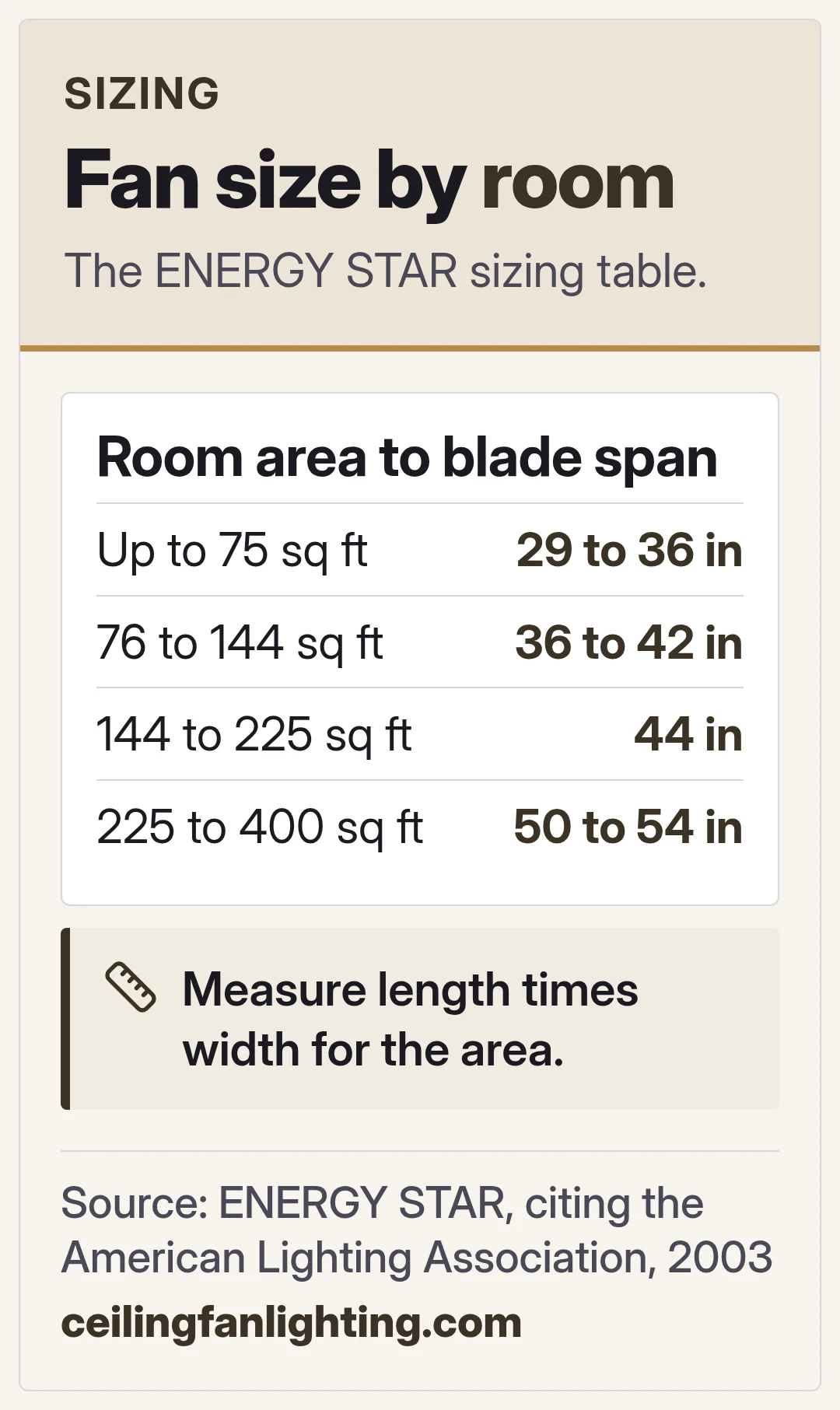
The ENERGY STAR sizing table
ENERGY STAR suggests 29 to 36 inch fans for rooms up to 75 sq ft, 36 to 42 inches for 76 to 144 sq ft, 44 inches for 144 to 225 sq ft, and 50 to 54 inches for 225 to 400 sq ft. It credits the table to the American Lighting Association, 2003.
Check the clearances too
ENERGY STAR says fans should be mounted in the middle of the room, at least 7 feet above the floor and 18 inches from the walls. One maker's manual asks for 30 inches from blade tip to the nearest wall or obstruction for one model. Check yours.
Larger rooms
The table stops at 400 sq ft. For a larger or oddly shaped room, ask the fan maker what it suggests.
Sources: ENERGY STAR, Ceiling Fan Basics; Hunter Fan, Warrant Ceiling Fan Installation Manual (PDF). Brand names belong to their owners. We are not affiliated with or endorsed by them.
FAQ
General information only. Ceiling fans and light fixtures are electrical equipment. Hire a licensed electrician for any installation, wiring, electrical box, switch, or light kit work, and follow the fan maker's manual and your local electrical code. Before cleaning, changing a bulb, or checking a fan, turn it off and let the blades stop and the bulbs cool; turn off power at the circuit breaker before any work near the fan's wiring. Use a stable ladder, and if you are not comfortable working overhead, call a pro. Never use a bulb above the maximum wattage marked on the fixture. If a fan or light flickers, buzzes, smells hot, or trips a breaker, stop using it and call a licensed electrician.


Next: height and downrods
Blade height and mounts.
